Articles in this blog's slice are, for the time being, ony in italian.
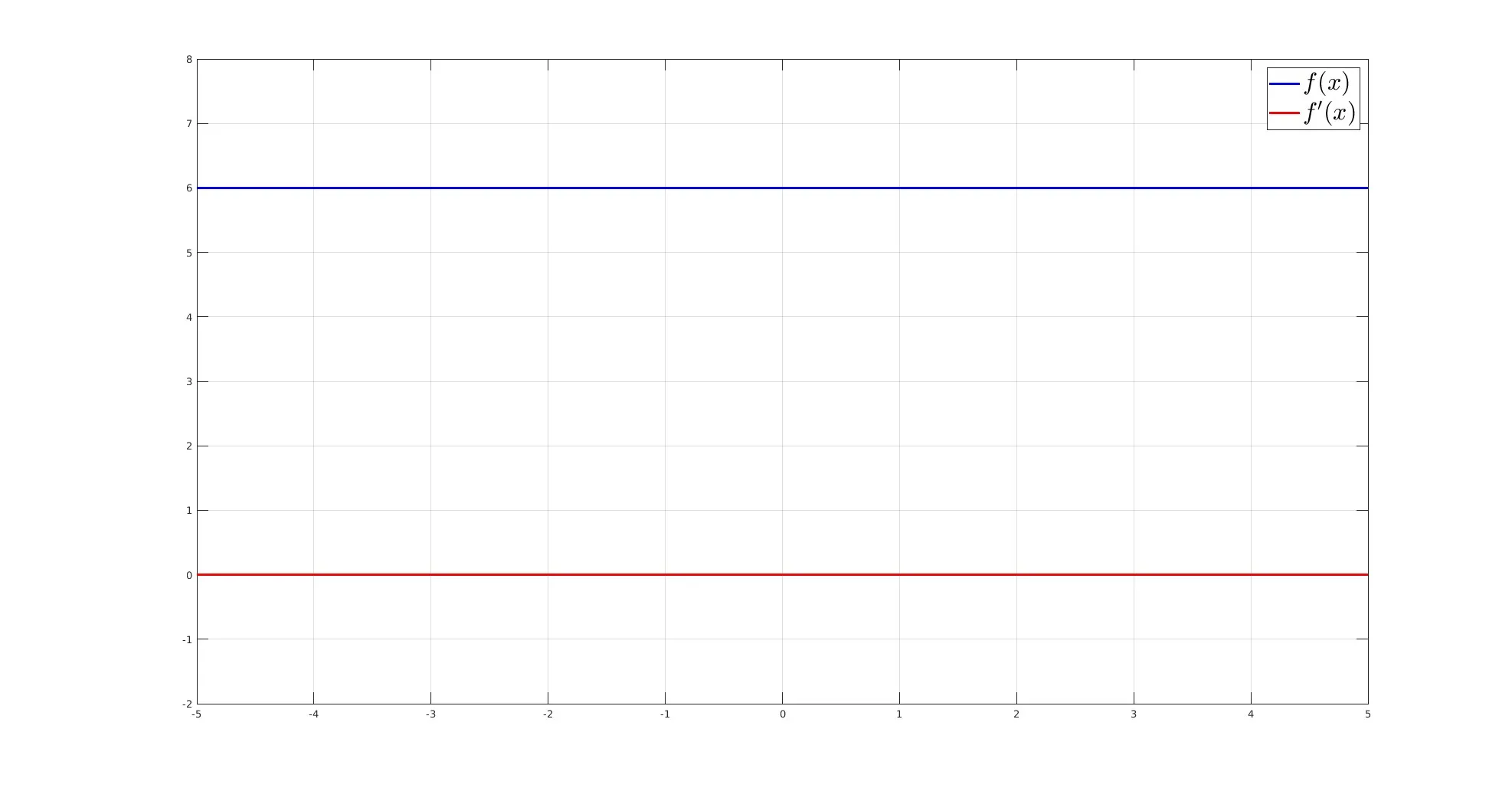
Teorema D k = 0 D\;k = 0 D k = 0
Dimostrazione f ( x ) = k f(x) = k f ( x ) = k f ( x + h ) = k f(x+h) = k f ( x + h ) = k
f ′ ( x ) = lim h → 0 f ( x + h ) − f ( x ) h = = lim h → 0 k − k h = 0 \eq{
f'(x) = &\lim\limits_{h\to0}\frac{f(x+h)-f(x)}{h} =\\
=& \lim\limits_{h\to0}\frac{k-k}{h} = 0
} f ′ ( x ) = = h → 0 lim h f ( x + h ) − f ( x ) = h → 0 lim h k − k = 0 Rappresentazione grafica y = k y=k y = k
f ( x ) = 2 ⟹ f ′ ( x ) = 0 f ( x ) = 15 ⟹ f ′ ( x ) = 0 f ( x ) = 230 ⟹ f ′ ( x ) = 0 \eq{
&f(x)= 2 \implies f'(x) = 0 \\
&f(x)= 15 \implies f'(x) = 0 \\
&f(x)= 230 \implies f'(x) = 0 \\
} f ( x ) = 2 ⟹ f ′ ( x ) = 0 f ( x ) = 15 ⟹ f ′ ( x ) = 0 f ( x ) = 230 ⟹ f ′ ( x ) = 0
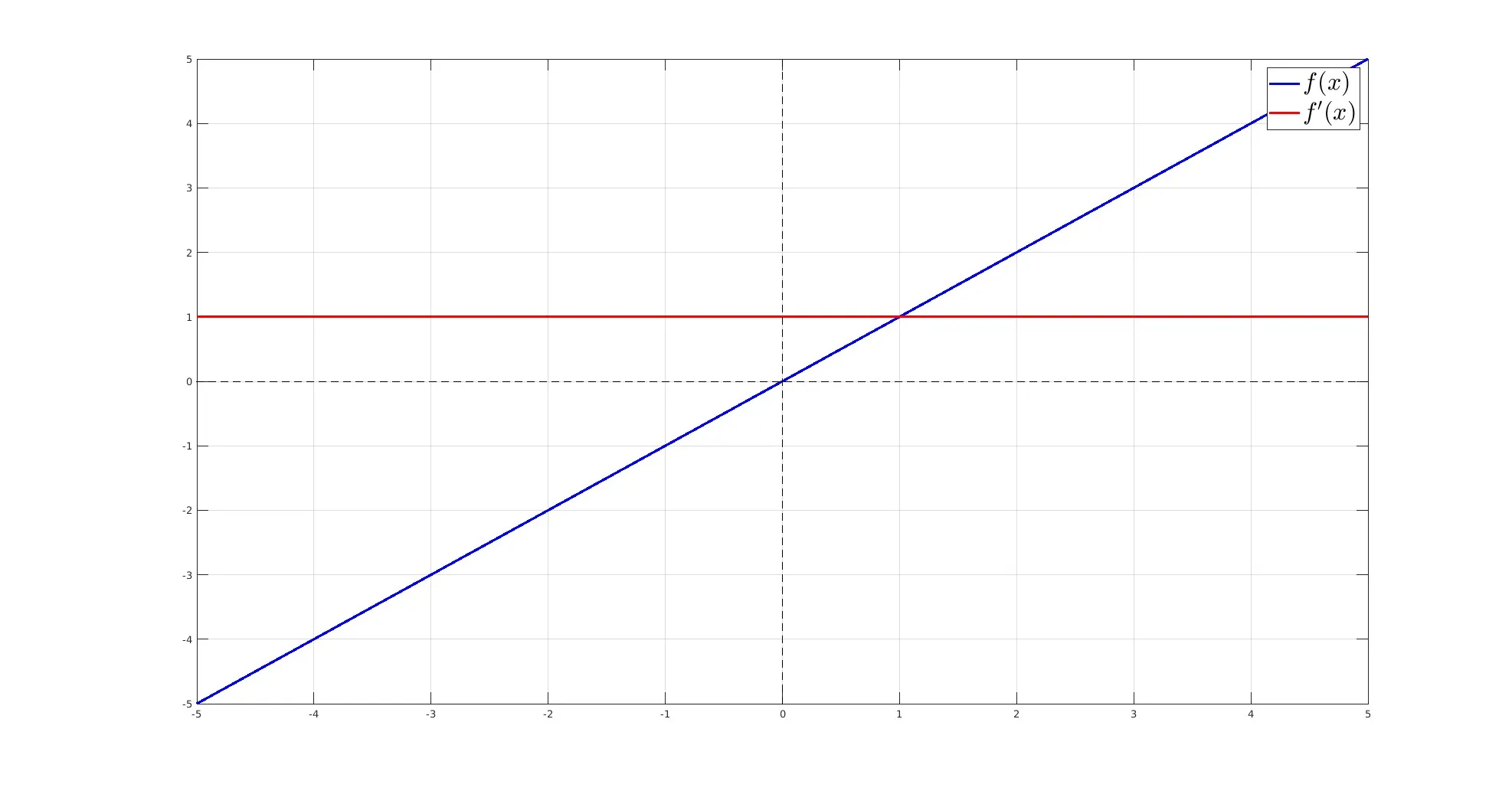
Teorema 1 1 1 D x = 1 D\;x = 1 D x = 1
f ′ ( x ) = lim h → 0 f ( x + h ) − f ( x ) h = = lim h → 0 x + h − x h = = lim h → 0 h h = 1 \eq{
f'(x) =& \lim\limits_{h\to0}\frac{f(x+h)-f(x)}{h} =\\
=& \lim\limits_{h\to0}\frac{x+h-x}{h} =\\
=&\lim\limits_{h\to0}\frac{h}{h} = 1
} f ′ ( x ) = = = h → 0 lim h f ( x + h ) − f ( x ) = h → 0 lim h x + h − x = h → 0 lim h h = 1 Rappresentazione grafica
La funzione identità è la bisettrice del primo e terzo quadrante e coincide con la tangente al grafico: il coefficiente angolare è uguale a 1 1 1
Esempio f ( x ) = x ⟹ f ′ ( x ) = 1 f(x)= x \implies f'(x) = 1 f ( x ) = x ⟹ f ′ ( x ) = 1
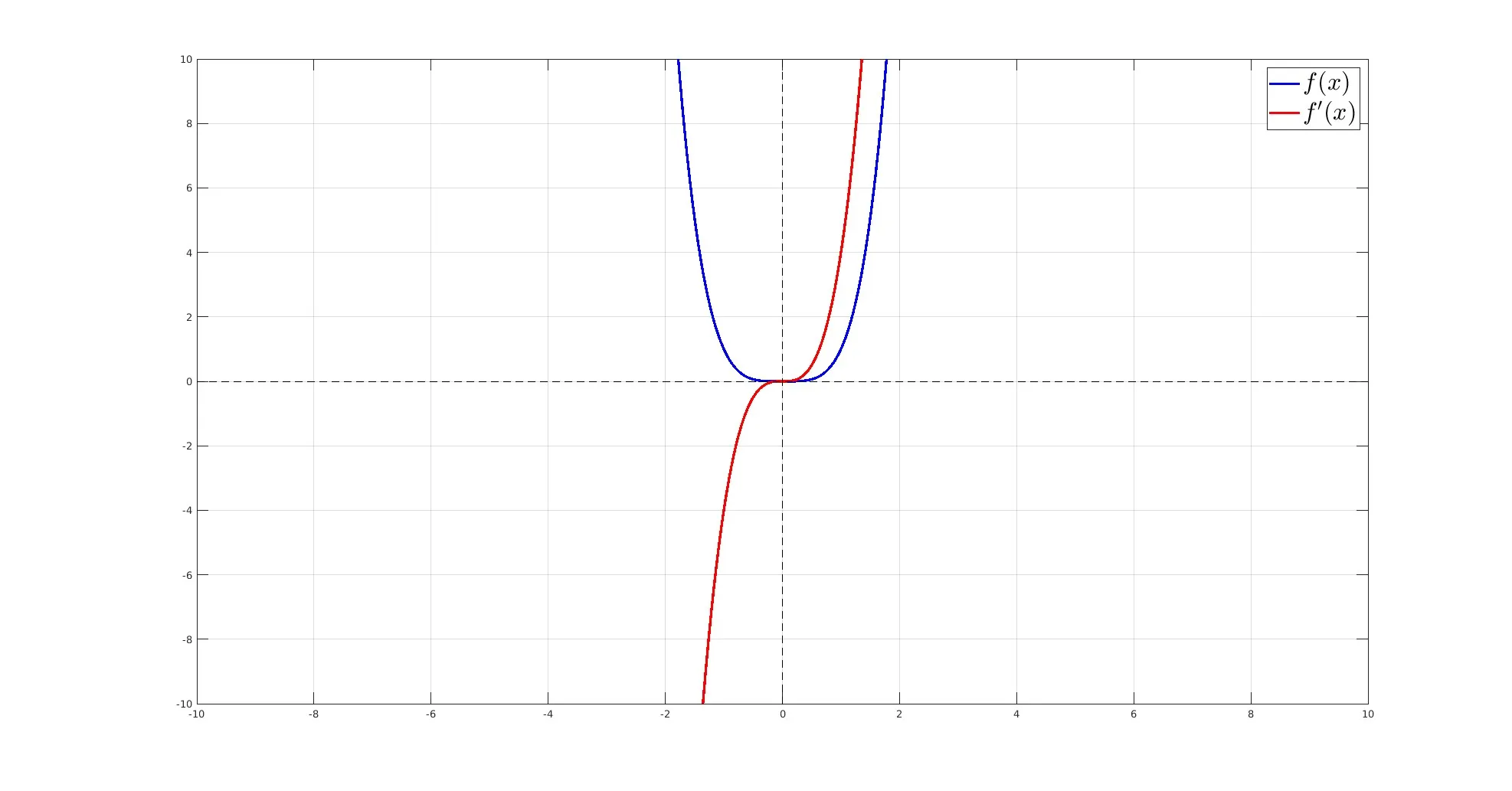
Teorema α ∈ R \alpha \in\R α ∈ R x > 0 x > 0 x > 0 D x α = α x α − 1 D x^\alpha = \alpha x^{\alpha-1} D x α = α x α − 1 α ∈ Z \alpha \in \Z α ∈ Z α = m n \alpha = \frac{m}{n} α = n m n n n x < 0 x<0 x < 0
Inoltre, per n ∈ N − { 0 } n \in \N-\{0\} n ∈ N − { 0 } ∀ x ∈ R \forall x \in\R ∀ x ∈ R D x n = n x n − 1 D x^n = nx^{n-1} D x n = n x n − 1
Dimostrazione
f ′ ( x ) = lim h → 0 f ( x + h ) − f ( x ) h = = lim h → 0 ( x + h ) α − x α h = = lim h → 0 x α ( 1 + h x ) α − x α h = = lim h → 0 x α ( 1 + h x ) α − 1 h = = lim h → 0 x α − 1 ( 1 + h x ) α − 1 h x = = α x α − 1 \eq{
f'(x) =& \lim\limits_{h\to0}\frac{f(x+h)-f(x)}{h} =\\
=& \lim\limits_{h\to0}\frac{(x+h)^\alpha-x^\alpha}{h} =\\
=& \lim\limits_{h\to0}\frac{x^\alpha(1+\frac{h}{x})^\alpha-x^\alpha}{h} =\\
=& \lim\limits_{h\to0}x^\alpha\frac{(1+\frac{h}{x})^\alpha-1}{h} =\\
=& \lim\limits_{h\to0}x^{\alpha-1}\frac{(1+\frac{h}{x})^\alpha-1}{\frac{h}{x}}=\\
=& \;\alpha x^{\alpha-1}
} f ′ ( x ) = = = = = = h → 0 lim h f ( x + h ) − f ( x ) = h → 0 lim h ( x + h ) α − x α = h → 0 lim h x α ( 1 + x h ) α − x α = h → 0 lim x α h ( 1 + x h ) α − 1 = h → 0 lim x α − 1 x h ( 1 + x h ) α − 1 = α x α − 1 Rappresentazione grafica
2° Teorema
Siano n ∈ R n \in\R n ∈ R x > 0 x > 0 x > 0
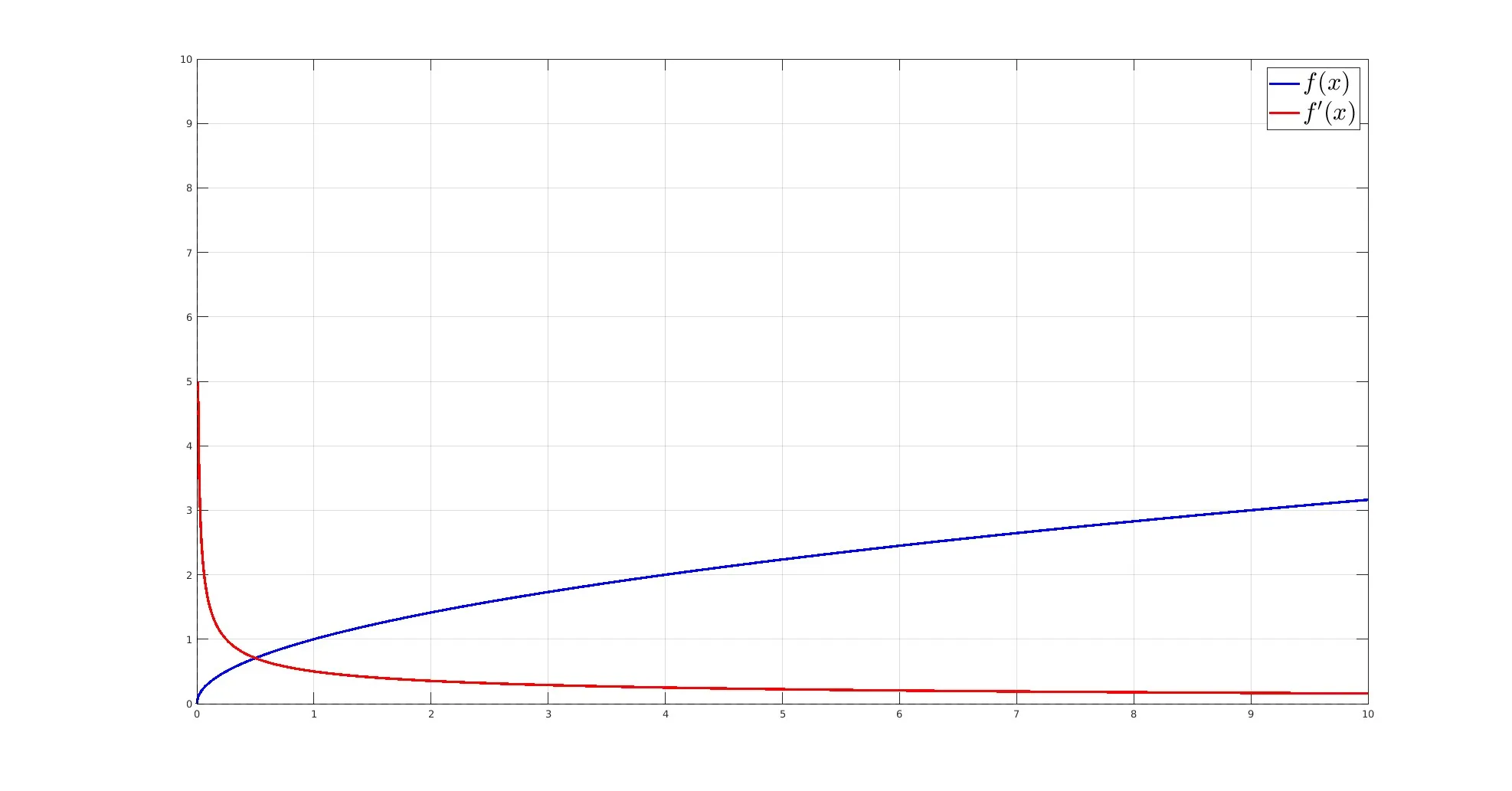
D [ 1 x n ] = n x n + 1 D \left[ \frac{1}{x^n} \right] = \frac{n}{x^{n+1}} D [ x n 1 ] = x n + 1 n Teorema α = 1 2 \alpha = \frac{1}{2} α = 2 1 x > 0 x > 0 x > 0 D x = D x α = 1 2 x D \sqrt{x} = D\;x^\alpha = \frac{1}{2\sqrt{x}} D x = D x α = 2 x 1
Dimostrazione ( a + b ) ( a − b ) = a 2 − b 2 (a+b)(a-b)=a^2-b^2 ( a + b ) ( a − b ) = a 2 − b 2
f ′ ( x ) = lim h → 0 f ( x + h ) − f ( x ) h = = lim h → 0 x + h − x h = = lim h → 0 ( x + h − x ) ( x + h + x ) h ( x + h + x ) = = lim h → 0 ( x + h − x ) h ( x + h + x ) = = lim h → 0 h h ( x + h + x ) = = lim h → 0 1 h ( x + x ) = 1 2 x \eq{
f'(x) =& \lim\limits_{h\to0}\frac{f(x+h)-f(x)}{h} =\\
=& \lim\limits_{h\to0}\frac{\sqrt{x+h}-\sqrt{x}}{h} =\\
=& \small
\lim\limits_{h\to0}\frac{(\sqrt{x+h}-\sqrt{x})(\sqrt{x+h}+\sqrt{x})}{h(\sqrt{x+h}+\sqrt{x})}=\\
=& \normalsize\lim\limits_{h\to0}\frac{(x+h-x)}{h(\sqrt{x+h}+\sqrt{x})} =\\
=& \lim\limits_{h\to0}\frac{h}{h(\sqrt{x+h}+\sqrt{x})} =\\
=& \lim\limits_{h\to0}\frac{1}{h(\sqrt{x}+\sqrt{x})} = \frac{1}{2\sqrt{x}}
} f ′ ( x ) = = = = = = h → 0 lim h f ( x + h ) − f ( x ) = h → 0 lim h x + h − x = h → 0 lim h ( x + h + x ) ( x + h − x ) ( x + h + x ) = h → 0 lim h ( x + h + x ) ( x + h − x ) = h → 0 lim h ( x + h + x ) h = h → 0 lim h ( x + x ) 1 = 2 x 1 Si ricava che D x = D x 1 2 = 1 2 x 1 2 − 1 = 1 2 x − 1 2 = 1 2 x ∀ x > 0 D \sqrt{x} = D x^{\frac{1}{2}} = \frac{1}{2} x^{\frac{1}{2}-1} = \frac{1}{2} x^{-\frac{1}{2}} = \frac{1}{2 \sqrt{x}} \quad \forall x > 0 D x = D x 2 1 = 2 1 x 2 1 − 1 = 2 1 x − 2 1 = 2 x 1 ∀ x > 0
Rappresentazione grafica
Teorema x x x D sin ( x ) = cos ( x ) D \sin(x) = \cos(x) D sin ( x ) = cos ( x )
Dimostrazione sin ( α + β ) = sin ( α ) ⋅ cos ( β ) + cos ( α ) ⋅ sin ( β ) \sin(\alpha+\beta)=\sin(\alpha)\cdot \cos(\beta)+\cos(\alpha)\cdot \sin(\beta) sin ( α + β ) = sin ( α ) ⋅ cos ( β ) + cos ( α ) ⋅ sin ( β )
f ′ ( x ) = lim h → 0 f ( x + h ) − f ( x ) h = = lim h → 0 sin ( x + h ) − sin ( x ) h = = lim h → 0 sin ( x ) ⋅ cos ( h ) + cos ( x ) ⋅ sin ( h ) − sin ( x ) h = = lim h → 0 sin ( x ) [ cos ( h ) − 1 ] + cos ( x ) ⋅ sin ( h ) h = = lim h → 0 sin ( x ) cos ( h ) − 1 h + cos ( x ) ⋅ sin ( h ) h = = sin ( x ) ⋅ 0 + cos ( x ) ⋅ 1 = cos ( x ) \eq{
f'(x) =& \lim\limits_{h\to0}\frac{f(x+h)-f(x)}{h} =\\
=& \lim\limits_{h\to0}\frac{\sin (x+h)- \sin(x)}{h} = \\
=& \lim\limits_{h\to0}\frac{\sin(x)\cdot \cos (h) + \cos (x)\cdot \sin(h)-\sin(x)}{h} = \\
=& \lim\limits_{h\to0}\frac{\sin(x)[\cos (h)-1]+\cos(x)\cdot \sin(h)}{h} = \\
=& \lim\limits_{h\to0} \sin(x)\frac{\cos(h)-1}{h}+ \cos(x)\cdot\frac{\sin(h)}{h} = \\
=& \;\sin(x)\cdot 0 + \cos(x)\cdot 1 = \cos (x)
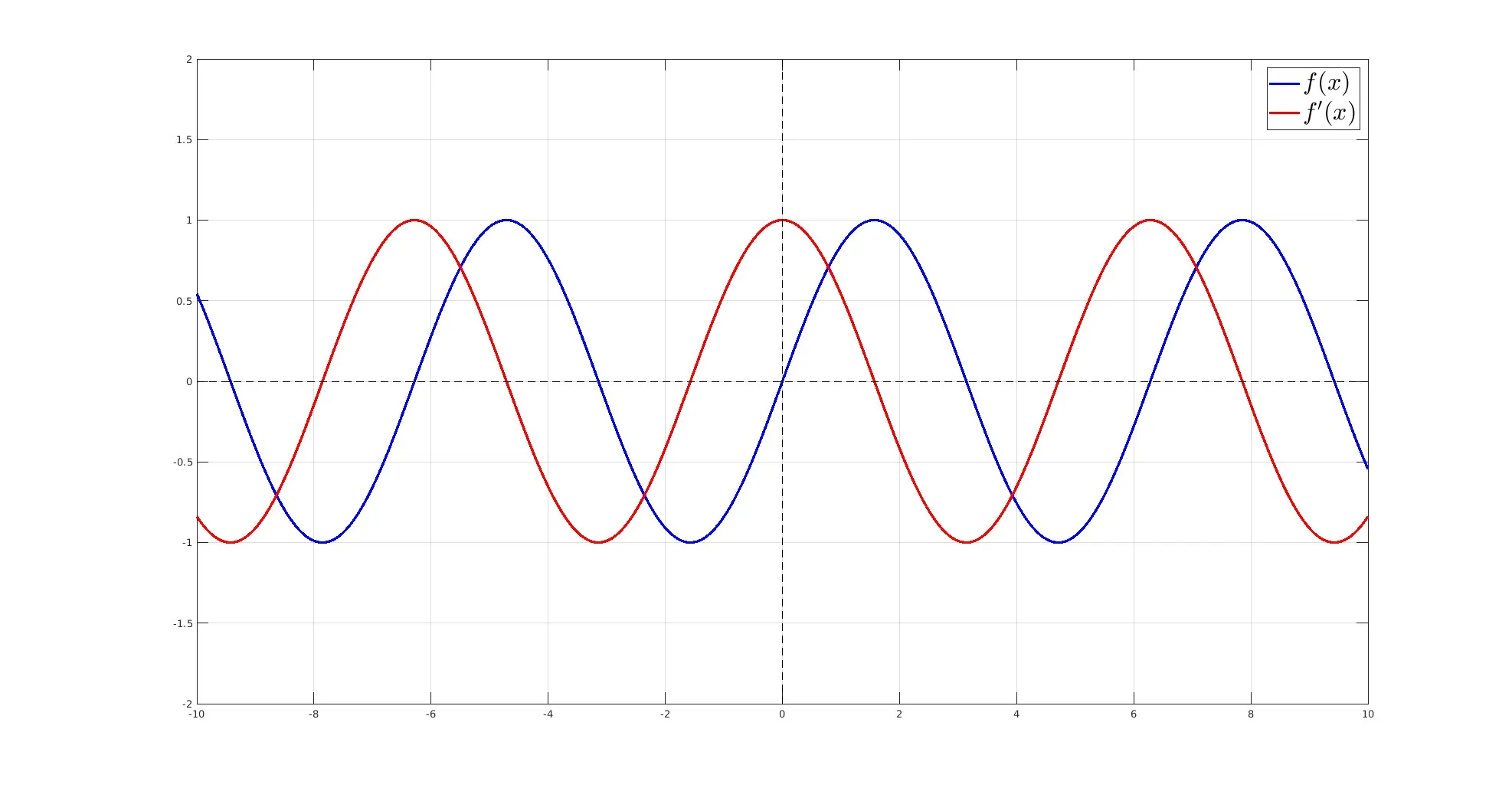
} f ′ ( x ) = = = = = = h → 0 lim h f ( x + h ) − f ( x ) = h → 0 lim h sin ( x + h ) − sin ( x ) = h → 0 lim h sin ( x ) ⋅ cos ( h ) + cos ( x ) ⋅ sin ( h ) − sin ( x ) = h → 0 lim h sin ( x ) [ cos ( h ) − 1 ] + cos ( x ) ⋅ sin ( h ) = h → 0 lim sin ( x ) h cos ( h ) − 1 + cos ( x ) ⋅ h sin ( h ) = sin ( x ) ⋅ 0 + cos ( x ) ⋅ 1 = cos ( x ) Rappresentazione grafica
La funzione seno è periodica con periodo 2 π 2\pi 2 π
Teorema x x x D [ cos ( x ) ] = − sin ( x ) D[\cos(x)] = -\sin(x) D [ cos ( x )] = − sin ( x )
Dimostrazione
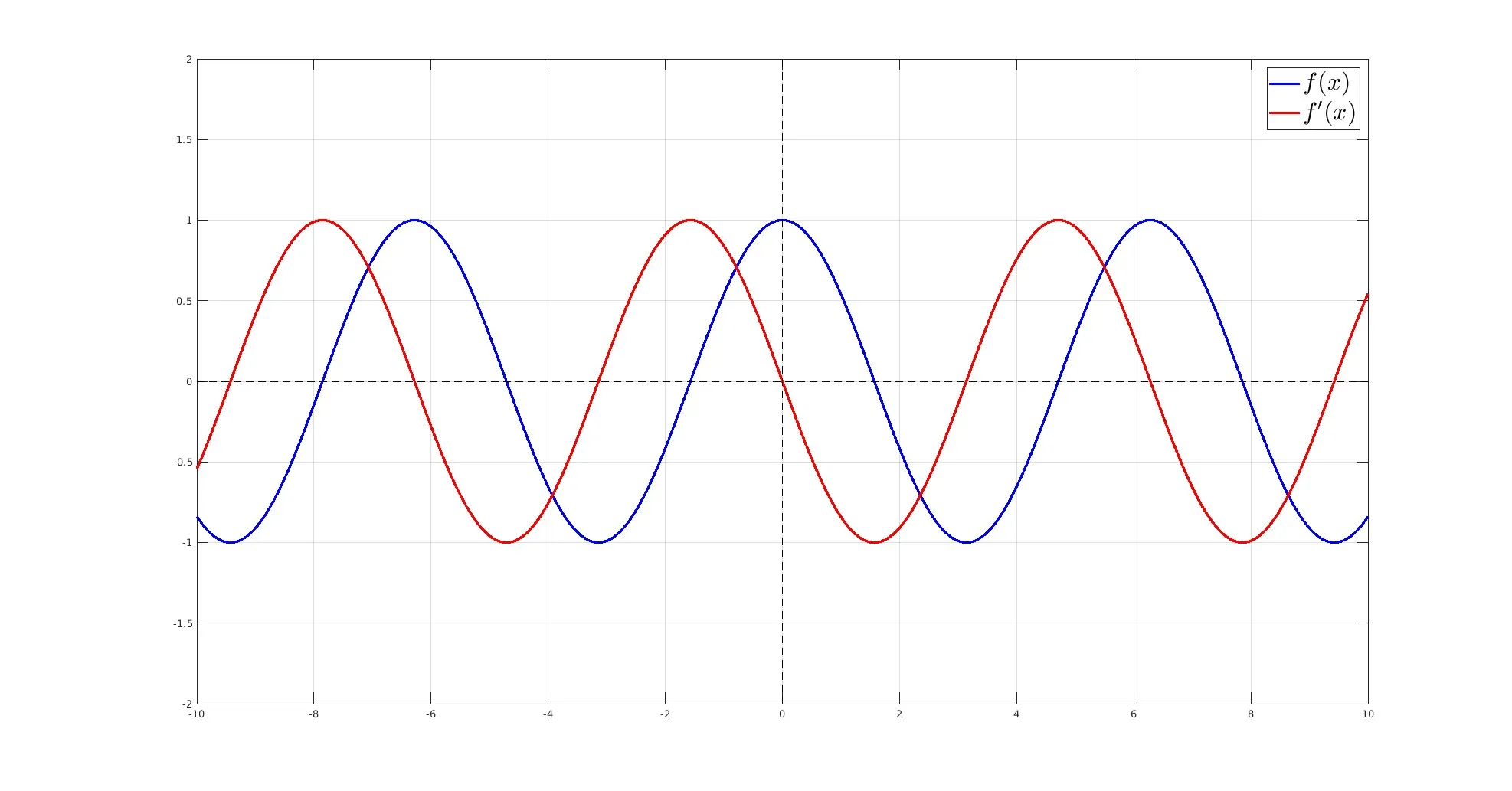
Rappresentazione grafica
La funzione coseno è periodica di periodo 2 π 2\pi 2 π
Teorema
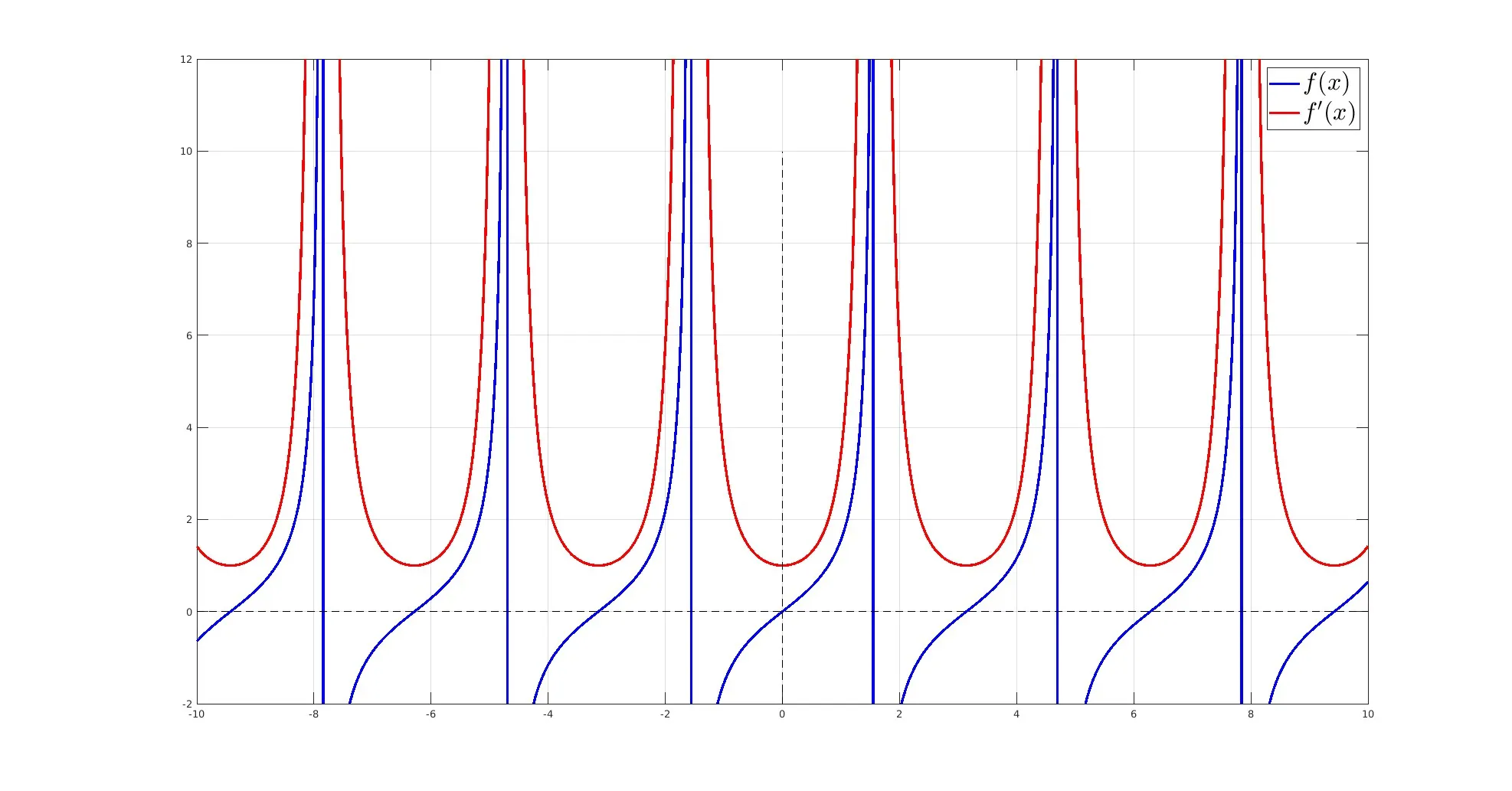
D tan ( x ) = 1 cos 2 ( x ) = 1 + tan 2 ( x ) D\;\tan(x) = \frac{1}{\cos^2(x)} = 1+\tan^2(x) D tan ( x ) = cos 2 ( x ) 1 = 1 + tan 2 ( x ) Rappresentazione grafica
Teorema
D arctan ( x ) = tan − 1 ( x ) = 1 x 2 + 1 D\;\text{arctan}(x) = \tan^{-1}(x) = \frac{1}{x^2+1} D arctan ( x ) = tan − 1 ( x ) = x 2 + 1 1 Teorema
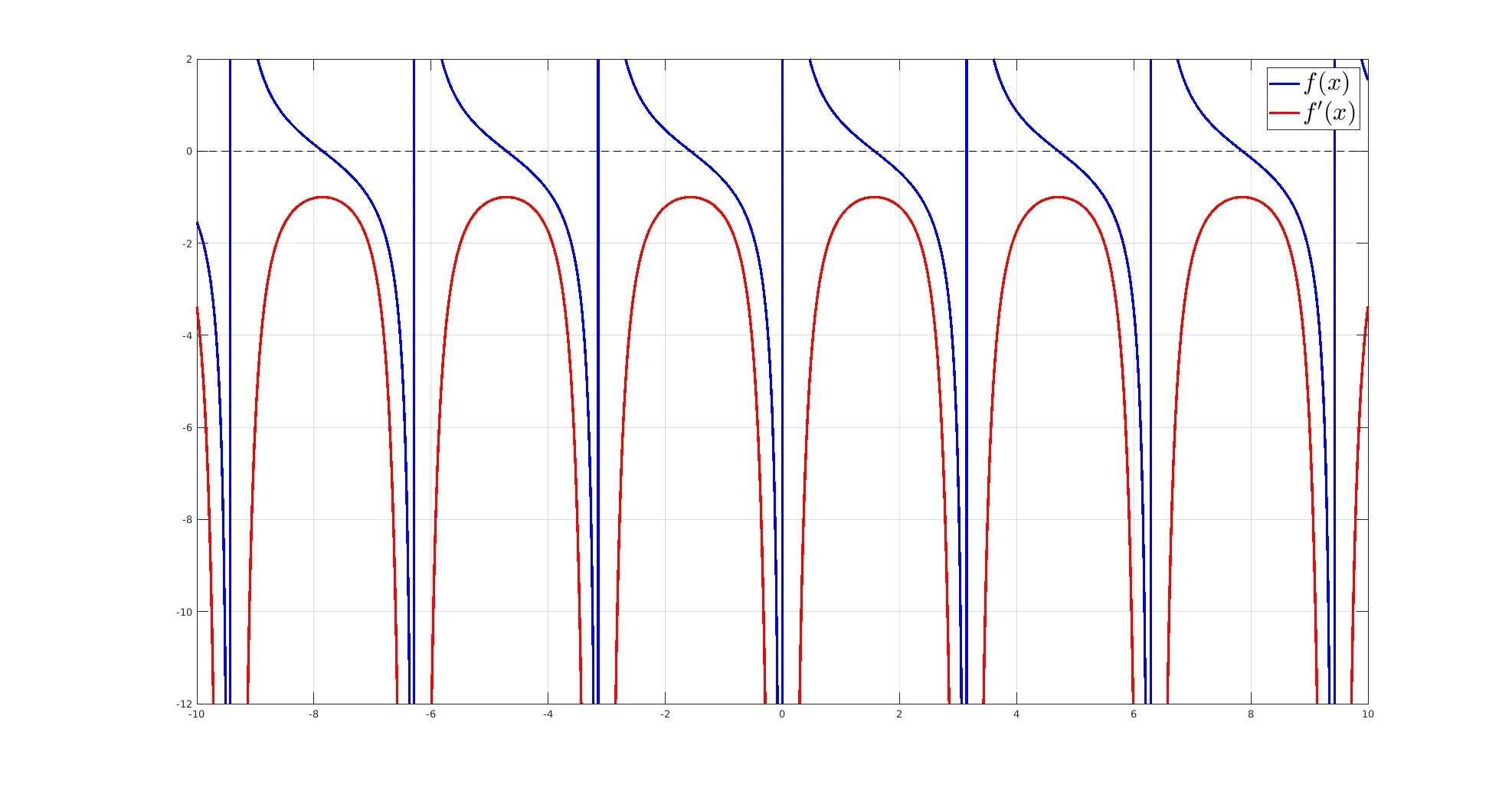
D cot ( x ) = − 1 sin 2 ( x ) = − [ 1 + c o t 2 ( x ) ] D\;\cot(x) = -\frac{1}{\sin^2(x)} = -[1+cot^2(x)] D cot ( x ) = − sin 2 ( x ) 1 = − [ 1 + co t 2 ( x )] Rappresentazione grafica
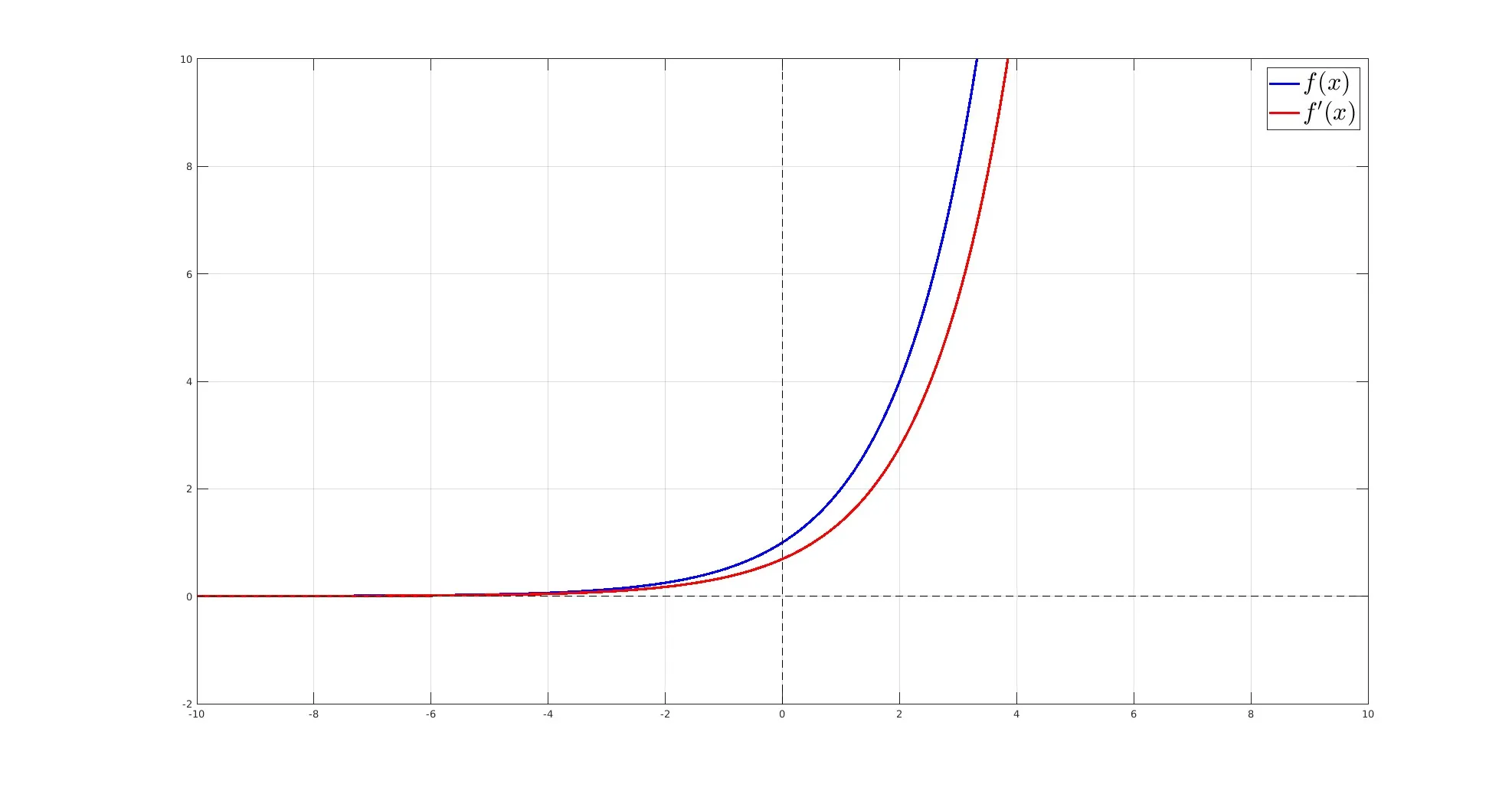
Teorema D α x = α x ⋅ log e ( α ) = α x ⋅ ln ( α ) D\;\alpha^x = \alpha^x \cdot \log_e(\alpha)=\alpha^x \cdot \ln(\alpha) D α x = α x ⋅ log e ( α ) = α x ⋅ ln ( α )
Se α = e \alpha = e α = e D α x = α x D\;\alpha^x = \alpha^x D α x = α x ln e = 1 \ln e = 1 ln e = 1
Dimostrazione
f ′ ( x ) = lim h → 0 f ( x + h ) − f ( x ) h = = lim h → 0 α x + h − α x h = = lim h → 0 α x ( α h − 1 ) h = = lim h → 0 ( α x α h − 1 h ) = = α x ⋅ ln α \eq{
f'(x) =& \lim\limits_{h\to0}\frac{f(x+h)-f(x)}{h} =\\
=& \lim\limits_{h\to0}\frac{\alpha^{x+h}-\alpha^x}{h} =\\
=& \lim\limits_{h\to0}\frac{\alpha^x(\alpha^h-1)}{h} =\\
=& \lim\limits_{h\to0}(\alpha^x\frac{\alpha^h-1}{h}) =\\
=& \;\alpha^x \cdot \ln\;\alpha
} f ′ ( x ) = = = = = h → 0 lim h f ( x + h ) − f ( x ) = h → 0 lim h α x + h − α x = h → 0 lim h α x ( α h − 1 ) = h → 0 lim ( α x h α h − 1 ) = α x ⋅ ln α Rappresentazione grafica
Esempio f ( x ) = 2 x ⟹ f ′ ( x ) = 2 x ⋅ ln ( 2 ) f(x)=2^x \implies f'(x)=2^x \cdot \ln(2) f ( x ) = 2 x ⟹ f ′ ( x ) = 2 x ⋅ ln ( 2 )
Teorema
D log α x = 1 x ⋅ log α e D\;\log_\alpha x = \frac{1}{x} \cdot \log_\alpha e D log α x = x 1 ⋅ log α e Se α = e \alpha = e α = e D ln x = 1 x D\;\ln x = \frac{1}{x} D ln x = x 1 D log x = 1 x D\;\log x = \frac{1}{x} D log x = x 1 D [ e x ] = e x D[e^x] = e^x D [ e x ] = e x
Dimostrazione log α x − log α y = log α x y \log_\alpha x - \log_\alpha y = \log_\alpha \frac{x}{y} log α x − log α y = log α y x
2° Teorema D log ∣ x ∣ = 1 x ∀ x ≠ 0 D \log |x| = \frac{1}{x} \quad \forall x \neq 0 D log ∣ x ∣ = x 1 ∀ x = 0
Se x > 0 x>0 x > 0 D [ log x ] = 1 x D[\log x] = \frac{1}{x} D [ log x ] = x 1
Se invece x < 0 x<0 x < 0
d d x log ∣ x ∣ = d d x log ( − x ) = d d x log y ∣ y = − x ⋅ d d x ( − x ) = 1 − x ( − 1 ) = 1 x \frac{d}{dx} \log |x| = \frac{d}{dx} \log(-x) = \frac{d}{dx} \log y|_{y=-x} \cdot \frac{d}{dx}(-x) = \frac{1}{-x}(-1) = \frac{1}{x} d x d log ∣ x ∣ = d x d log ( − x ) = d x d log y ∣ y = − x ⋅ d x d ( − x ) = − x 1 ( − 1 ) = x 1
3° Teorema
D log ∣ f ( x ) ∣ = f ′ ( x ) f ( x ) ∀ f ( x ) ≠ 0 D \log |f(x)| = \frac{f'(x)}{f(x)} \quad \forall f(x)\neq 0 D log ∣ f ( x ) ∣ = f ( x ) f ′ ( x ) ∀ f ( x ) = 0 Dimostrazione
D log ∣ f ( x ) ∣ = 1 f ( x ) ⋅ f ′ ( x ) = f ′ ( x ) f ( x ) D \log |f(x)| = \frac{1}{f(x)} \cdot f'(x) = \frac{f'(x)}{f(x)} D log ∣ f ( x ) ∣ = f ( x ) 1 ⋅ f ′ ( x ) = f ( x ) f ′ ( x ) Teorema I = ( a ; b ) , f : I ⟶ R , x 0 ∈ I I= (a; \; b), \; f: I \lto \R, \; x_0 \in I I = ( a ; b ) , f : I ⟶ R , x 0 ∈ I f f f I I I x 0 x_0 x 0 f ′ ( x 0 ) ≠ 0 f'(x_0) \ne 0 f ′ ( x 0 ) = 0 f − 1 f^{-1} f − 1 y 0 = f ( x 0 ) y_0=f(x_0) y 0 = f ( x 0 )
( f − 1 ) ′ ( y 0 ) = 1 f ′ ( x 0 ) D [ f − 1 ( y ) ] = 1 f ′ ( x ) \eq{
\left( f^{-1} \right)' (y_0) =\frac{1}{f'(x_0)} \\
D[f^{-1}(y)]=\frac{1}{f'(x)}
} ( f − 1 ) ′ ( y 0 ) = f ′ ( x 0 ) 1 D [ f − 1 ( y )] = f ′ ( x ) 1 Dimostrazione y = f ( x ) ⟺ x = f − 1 ( y ) : y = f(x)\iff x = f^{-1} (y): y = f ( x ) ⟺ x = f − 1 ( y ) :
D [ f − 1 ( y ) ] = = lim y → y 0 f − 1 ( y ) − f − 1 ( y 0 ) y − y 0 = = lim y → y 0 f − 1 ( f ( x ) ) f − 1 ( f ( x 0 ) ) f ( x ) − f ( x 0 ) = = lim y → y 0 x − x 0 f ( x ) − f ( x 0 ) = = lim y → y 0 1 f ( x ) − f ( x 0 ) x − x 0 = 1 f ′ ( x 0 ) \eq{
& D[f^{-1}(y)]=\\
=&\lim\limits_{y \to y_0} \frac{f^{-1}(y)-f^{-1}(y_0)}{y - y_0} =\\
=& \lim\limits_{y \to y_0} \frac{f^{-1} \left( f(x)\right) f^{-1}\left( f(x_0) \right)}{f(x)- f(x_0)} =\\
=& \lim\limits_{y \to y_0} \frac{x - x_0}{f(x)- f(x_0)} =\\
=&\lim\limits_{y \to y_0} \frac{1}{\frac{f(x)- f(x_0)}{x - x_0}} = \frac{1}{f'(x_0)} \\
} = = = = D [ f − 1 ( y )] = y → y 0 lim y − y 0 f − 1 ( y ) − f − 1 ( y 0 ) = y → y 0 lim f ( x ) − f ( x 0 ) f − 1 ( f ( x ) ) f − 1 ( f ( x 0 ) ) = y → y 0 lim f ( x ) − f ( x 0 ) x − x 0 = y → y 0 lim x − x 0 f ( x ) − f ( x 0 ) 1 = f ′ ( x 0 ) 1 f ∈ C ( I ) f \in C(I) f ∈ C ( I ) ⟹ f − 1 ∈ C ( I ) \implies f^{-1} \in C(I) ⟹ f − 1 ∈ C ( I )
Se x → x 0 ⟹ f − 1 ( x ) → f − 1 ( x 0 ) ⟺ y → y 0 x \to x_0 \implies f^{-1}(x) \to f^{-1}(x_0) \iff y \to y_0 x → x 0 ⟹ f − 1 ( x ) → f − 1 ( x 0 ) ⟺ y → y 0 x → x 0 ⟺ y → y 0 x \to x_0 \iff y \to y_0 x → x 0 ⟺ y → y 0
Esempio 1 f ( x ) = x 3 + x f(x)=x^3+x f ( x ) = x 3 + x R \R R y = 2 y=2 y = 2 x x x y = 2 y=2 y = 2
x 3 + x = 2 ⟹ ( x − 1 ) ( x 2 + x + 2 ) = 0 ⟹ x = 1 ⟹ f ′ ( x ) = 3 x 2 + 1 ⟹ f ′ ( 1 ) = 3 + 1 = 4 \eq{
& x^3+x=2 \\
\implies & (x-1)(x^2+x+2)=0\\
\implies & x=1 \\
\implies & f'(x)=3x^2+1 \\
\implies & f'(1)=3+1=4
} ⟹ ⟹ ⟹ ⟹ x 3 + x = 2 ( x − 1 ) ( x 2 + x + 2 ) = 0 x = 1 f ′ ( x ) = 3 x 2 + 1 f ′ ( 1 ) = 3 + 1 = 4 Si applichi il teorema: D [ f − 1 ( 2 ) ] = 1 f ′ ( 1 ) = 1 4 D[f^{-1}(2)]=\frac{1}{f'(1)}=\frac{1}{4} D [ f − 1 ( 2 )] = f ′ ( 1 ) 1 = 4 1
Esempio 2
D [ arcsin ( x ) ] = 1 1 − x 2 ∀ x ∈ ( − 1 , 1 ) D [ arcsin ( x ) ] = 1 D sin y ∣ y = arcsin x = = 1 cos y ∣ y = arcsin y = = 1 1 − sin 2 y ∣ y = arcsin x = = 1 1 − x 2 \eq{
D \Big[\text{arcsin}(x)\Big] =& \frac{1}{\sqrt{1-x^2}} \quad \forall x \in (-1, \; 1) \\
D \Big[\text{arcsin}(x)\Big] =& \frac{1}{D\sin y} \LARGE| \normalsize _{ y = \text{arcsin } x } =\\
=& \frac{1}{\cos y |_{y = \text{arcsin } y}} =\\
=& \frac{1}{\sqrt{1-\sin^2 y}} \LARGE| \normalsize _{ y = \text{arcsin } x } =\\
=& \frac{1}{\sqrt{1-x^2}}
} D [ arcsin ( x ) ] = D [ arcsin ( x ) ] = = = = 1 − x 2 1 ∀ x ∈ ( − 1 , 1 ) D sin y 1 ∣ y = arcsin x = cos y ∣ y = arcsin y 1 = 1 − sin 2 y 1 ∣ y = arcsin x = 1 − x 2 1 Non dimenticarti che:
cos 2 ( y ) + sin 2 ( y ) = 1 \cos^2 (y) + \sin^2 (y)=1 cos 2 ( y ) + sin 2 ( y ) = 1
y = log a ( x ) ⟺ a y = x y =\log_a(x) \iff a^y = x y = log a ( x ) ⟺ a y = x
a log a x = x a^{\log_a x} = x a l o g a x = x
D [ arccos ( x ) ] = − 1 1 − x 2 ∀ x ∈ ( − 1 , 1 ) D [ arctg ( x ) ] = 1 1 + x 2 ∀ x ∈ R D [ log a ( x ) ] = 1 x log a ∀ x > 0 , a > 0 , a ≠ 1 D [ log a ( x ) ] = 1 D a y ∣ y = log a x = = 1 a y log a ∣ y = log a x = = 1 x log a \eq{
D \Big[\text{arccos}(x)\Big] =& - \frac{1}{\sqrt{1-x^2}} \quad \forall x \in (-1, \; 1) \\
D \Big[\text{arctg}(x)\Big] =& \frac{1}{1+x^2} \quad \forall x \in \R \\
D \Big[\log_a (x)\Big] =& \frac{1}{x \log a} \quad \forall x > 0, \; a > 0, \; a \neq 1 \\
D \Big[\log_a (x)\Big] =& \frac{1}{D a^y} \LARGE| \normalsize _{y = \log_a x} = \\
=& \frac{1}{a^y \log a} \LARGE| \normalsize _{y = \log_a x} =\\
=&\frac{1}{x \log a}
} D [ arccos ( x ) ] = D [ arctg ( x ) ] = D [ log a ( x ) ] = D [ log a ( x ) ] = = = − 1 − x 2 1 ∀ x ∈ ( − 1 , 1 ) 1 + x 2 1 ∀ x ∈ R x log a 1 ∀ x > 0 , a > 0 , a = 1 D a y 1 ∣ y = l o g a x = a y log a 1 ∣ y = l o g a x = x log a 1 Teorema I , J ⊆ R , g : I ⟶ R , f : J ⟶ R , g ( I ) ⊆ J , x 0 ∈ I I, \; J \subseteq
\R, \; g: I \lto \R, \; f: J \lto\R, \; g(I) \subseteq
J, \; x_0 \in I I , J ⊆ R , g : I ⟶ R , f : J ⟶ R , g ( I ) ⊆ J , x 0 ∈ I g g g x 0 x_0 x 0 f f f g ( x 0 ) g(x_0) g ( x 0 ) f ∘ g = f ( g ( x ) ) f \circ g = f(g(x)) f ∘ g = f ( g ( x )) x 0 x_0 x 0
D [ f ( g ( x ) ) ] = f ′ ( g ( x ) ) ⋅ g ′ ( x ) D[f(g(x))]=f'(g(x)) \cdot g'(x) D [ f ( g ( x ))] = f ′ ( g ( x )) ⋅ g ′ ( x ) Esempio 1 D [ x α ] = α x α − 1 ∀ x > 0 , α ∈ R D[x^{\alpha}] = \alpha x ^{\alpha -1} \quad \forall x > 0, \; \alpha \in \R D [ x α ] = α x α − 1 ∀ x > 0 , α ∈ R
D [ x α ] = D [ e ln ( x α ) ] = = D [ e α ln ( x ) ] = = f ∘ g t.c. g ( x ) = α ln ( x ) , f ( y ) = e y ⟹ D [ e y ∣ y = α ln ( x ) ] ⋅ D [ α ln ( x ) ] = = e α ln ( x ) α 1 x = = α x α − 1 \eq{
D[x^{\alpha}] =& D[e^{\ln (x^{\alpha})}] =\\
=& D[e^{\alpha \ln (x)}] =\\
=& \; f \circ g \text{ t.c. } g(x) = \alpha \ln (x) , \; f(y) = e^y \\
\implies & \; D[e^y |_{y= \alpha \ln (x)}] \cdot D[\alpha \ln (x)] =\\
=& \; e^{\alpha \ln (x)} \alpha \frac{1}{x} =\\
=& \;\alpha x^{\alpha -1}
} D [ x α ] = = = ⟹ = = D [ e l n ( x α ) ] = D [ e α l n ( x ) ] = f ∘ g t.c. g ( x ) = α ln ( x ) , f ( y ) = e y D [ e y ∣ y = α l n ( x ) ] ⋅ D [ α ln ( x )] = e α l n ( x ) α x 1 = α x α − 1 Esempio 2 D a x = a x ⋅ log a ∀ x ∈ R , a > 0 D \; a^x = a^x \cdot \log a \quad \quad \quad \forall x \in \R, a > 0 D a x = a x ⋅ log a ∀ x ∈ R , a > 0
D [ a x ] = D [ e log a x ] = = D [ e x log a ] = = f ∘ g ( x ) t.c. g ( x ) = x log a , f ( y ) = e y ⟹ D e y ∣ y = x log a ⋅ D ( x log a ) = e x log a ⋅ log a ⋅ 1 = = a x ⋅ log a \eq{
D[a^x] =& D[e^{\log a^x}] =\\
=& D [e^{x \log a}] =\\
=& \; f \circ g(x) \text{ t.c. }g(x) = x \log a , \; f(y) = e^y \\
\implies & D e^y |_{y= x \log a} \cdot D(x \log a) \\
=& \; e^{x \log a} \cdot \log a \cdot 1 =\\
=& a^x \cdot \log a
} D [ a x ] = = = ⟹ = = D [ e l o g a x ] = D [ e x l o g a ] = f ∘ g ( x ) t.c. g ( x ) = x log a , f ( y ) = e y D e y ∣ y = x l o g a ⋅ D ( x log a ) e x l o g a ⋅ log a ⋅ 1 = a x ⋅ log a Teorema
D [ k ⋅ f ( x ) ] = k ⋅ f ′ ( x ) D\;[k \cdot f(x)]= k \cdot f'(x) D [ k ⋅ f ( x )] = k ⋅ f ′ ( x ) Dimostrazione
f ′ ( x ) = lim h → 0 k ⋅ f ( x + h ) − k ⋅ f ( x ) h = = lim h → 0 k ⋅ [ f ( x + h ) − f ( x ) ] h = = lim h → 0 k f ( x + h ) − f ( x ) h = k ⋅ f ′ ( x ) \eq{
f'(x) =& \lim\limits_{h\to0}\frac{k \cdot f(x+h)- k \cdot f(x)}{h} = \\
=& \lim\limits_{h\to0}\frac{k \cdot [f(x+h)- f(x)]}{h} =\\
=& \lim\limits_{h\to0}k\;\frac{f(x+h)- f(x)}{h} = k\;\cdot\;f'(x)
} f ′ ( x ) = = = h → 0 lim h k ⋅ f ( x + h ) − k ⋅ f ( x ) = h → 0 lim h k ⋅ [ f ( x + h ) − f ( x )] = h → 0 lim k h f ( x + h ) − f ( x ) = k ⋅ f ′ ( x ) Esempio y = − 3 ⋅ ln x ⟹ y ′ = − 3 ⋅ 1 x = − 3 x y=-3 \; \cdot \ln x \implies y' = -3 \cdot \frac{1}{x}= -\frac{3}{x} y = − 3 ⋅ ln x ⟹ y ′ = − 3 ⋅ x 1 = − x 3
Teorema D [ f ( x ) ± g ( x ) ] = f ′ ( x ) ± g ′ ( x ) D\;[f(x) \pm g(x)]= f'(x) \pm g'(x) D [ f ( x ) ± g ( x )] = f ′ ( x ) ± g ′ ( x )
Dimostrazione I ) Sia h ( x ) = f ( x ) + g ( x ) h(x) = f(x)+ g(x) h ( x ) = f ( x ) + g ( x ) D [ h ( x ) ] = f ′ ( x ) + g ′ ( x ) D[h(x)]=f'(x) + g'(x) D [ h ( x )] = f ′ ( x ) + g ′ ( x )
h ′ ( x ) = lim h → 0 [ f ( x + h ) + g ( x + h ) ] − [ f ( x ) + g ( x ) ] h = = lim h → 0 [ f ( x + h ) − f ( x ) ] + [ g ( x + h ) − g ( x ) ] h = = lim h → 0 f ( x + h ) − f ( x ) h + lim h → 0 g ( x + h ) − g ( x ) h = = f ′ ( x ) + g ′ ( x ) \eq{
h'(x) =& \lim\limits_{h\to0}\frac{[f(x+h)+g(x+h)]-[f(x)+g(x)]}{h} =\\
=& \lim\limits_{h\to0}\frac{[f(x+h)-f(x)]+[g(x+h)-g(x)]}{h} =\\
=& \lim\limits_{h\to0}\frac{f(x+h)-f(x)}{h} + \lim\limits_{h\to0}\frac{g(x+h)-g(x)}{h} =\\
=&f'(x) + g'(x)
} h ′ ( x ) = = = = h → 0 lim h [ f ( x + h ) + g ( x + h )] − [ f ( x ) + g ( x )] = h → 0 lim h [ f ( x + h ) − f ( x )] + [ g ( x + h ) − g ( x )] = h → 0 lim h f ( x + h ) − f ( x ) + h → 0 lim h g ( x + h ) − g ( x ) = f ′ ( x ) + g ′ ( x ) II ) Sia v ( x ) = f ( x ) − g ( x ) v(x) = f(x)- g(x) v ( x ) = f ( x ) − g ( x ) D [ v ( x ) ] = f ′ ( x ) − g ′ ( x ) D[v(x)]=f'(x) - g'(x) D [ v ( x )] = f ′ ( x ) − g ′ ( x )
v ′ ( x ) = lim h → 0 [ f ( x + h ) − g ( x + h ) ] − [ f ( x ) − g ( x ) ] h = = lim h → 0 [ f ( x + h ) − f ( x ) ] − [ g ( x + h ) − g ( x ) ] h = = lim h → 0 f ( x + h ) − f ( x ) h − lim h → 0 g ( x + h ) − g ( x ) h = = f ′ ( x ) − g ′ ( x ) \eq{
v'(x) =& \lim\limits_{h\to0}\frac{[f(x+h)-g(x+h)]-[f(x)-g(x)]}{h} =\\
& = \lim\limits_{h\to0}\frac{[f(x+h)-f(x)]-[g(x+h)-g(x)]}{h} =\\
& = \lim\limits_{h\to0}\frac{f(x+h)-f(x)}{h} - \lim\limits_{h\to0}\frac{g(x+h)-g(x)}{h} =\\
=& f'(x) - g'(x)
} v ′ ( x ) = = h → 0 lim h [ f ( x + h ) − g ( x + h )] − [ f ( x ) − g ( x )] = = h → 0 lim h [ f ( x + h ) − f ( x )] − [ g ( x + h ) − g ( x )] = = h → 0 lim h f ( x + h ) − f ( x ) − h → 0 lim h g ( x + h ) − g ( x ) = f ′ ( x ) − g ′ ( x ) Esempio f ( x ) = x f(x) = x f ( x ) = x g ( x ) = 2 ⋅ sin ( x ) g(x)=2 \cdot \sin(x) g ( x ) = 2 ⋅ sin ( x ) y = x + 2 ⋅ sin ( x ) ⟹ y ′ = 1 + 2 ⋅ cos ( x ) y = x+2 \cdot \sin(x) \implies y'=1+2 \cdot \cos(x) y = x + 2 ⋅ sin ( x ) ⟹ y ′ = 1 + 2 ⋅ cos ( x )
Teorema
d d x [ f ( x ) ⋅ g ( x ) ] = f ′ ( x ) ⋅ g ( x ) + f ( x ) ⋅ g ′ ( x ) \frac{d}{dx} [f(x) \cdot g(x)]= f'(x) \cdot g(x) + f(x) \cdot g'(x) d x d [ f ( x ) ⋅ g ( x )] = f ′ ( x ) ⋅ g ( x ) + f ( x ) ⋅ g ′ ( x ) Esempio f ( x ) = x f(x) = x f ( x ) = x g ( x ) = sin ( x ) g(x)=\sin(x) g ( x ) = sin ( x ) y = x ⋅ sin ( x ) ⟹ y ′ = 1 ⋅ sin ( x ) + x ⋅ cos ( x ) y = x \cdot \sin(x) \implies y'=1 \cdot \sin(x) + x \cdot \cos(x) y = x ⋅ sin ( x ) ⟹ y ′ = 1 ⋅ sin ( x ) + x ⋅ cos ( x )
Teorema g ( x ) ≠ 0 g(x) \ne 0 g ( x ) = 0
d d x [ f ( x ) g ( x ) ] = f ′ ( x ) ⋅ g ( x ) − f ( x ) ⋅ g ′ ( x ) [ g ( x ) ] 2 \frac{d}{dx} \left[ \frac{f(x)}{g(x)} \right]= \frac{f'(x) \cdot g(x) - f(x) \cdot g'(x)}{[g(x)]^2} d x d [ g ( x ) f ( x ) ] = [ g ( x ) ] 2 f ′ ( x ) ⋅ g ( x ) − f ( x ) ⋅ g ′ ( x ) Teorema f ( x ) ≠ 0 f(x) \ne 0 f ( x ) = 0
d d x [ 1 f ( x ) ] = − f ′ ( x ) [ f ( x ) ] 2 \frac{d}{dx} \left[ \frac{1}{f(x)} \right] = -\frac{f'(x)}{ [f(x)]^2} d x d [ f ( x ) 1 ] = − [ f ( x ) ] 2 f ′ ( x ) Esempio f ( x ) = sin ( x ) f(x)=\sin(x) f ( x ) = sin ( x )
y = 1 sin ( x ) ⟹ y ′ = − cos ( x ) sin 2 ( x ) y=\frac{1}{\sin(x)} \implies y'=-\frac{\cos(x)}{\sin^2(x)} y = sin ( x ) 1 ⟹ y ′ = − sin 2 ( x ) cos ( x ) Teorema n ∈ N , n > 1 n \in \N, n > 1 n ∈ N , n > 1
d d x [ f ( x ) ] n = n ⋅ [ f ( x ) ] n − 1 ⋅ f ′ ( x ) \frac{d}{dx}[f(x)]^n=n \cdot [f(x)]^{n-1} \cdot f'(x) d x d [ f ( x ) ] n = n ⋅ [ f ( x ) ] n − 1 ⋅ f ′ ( x )